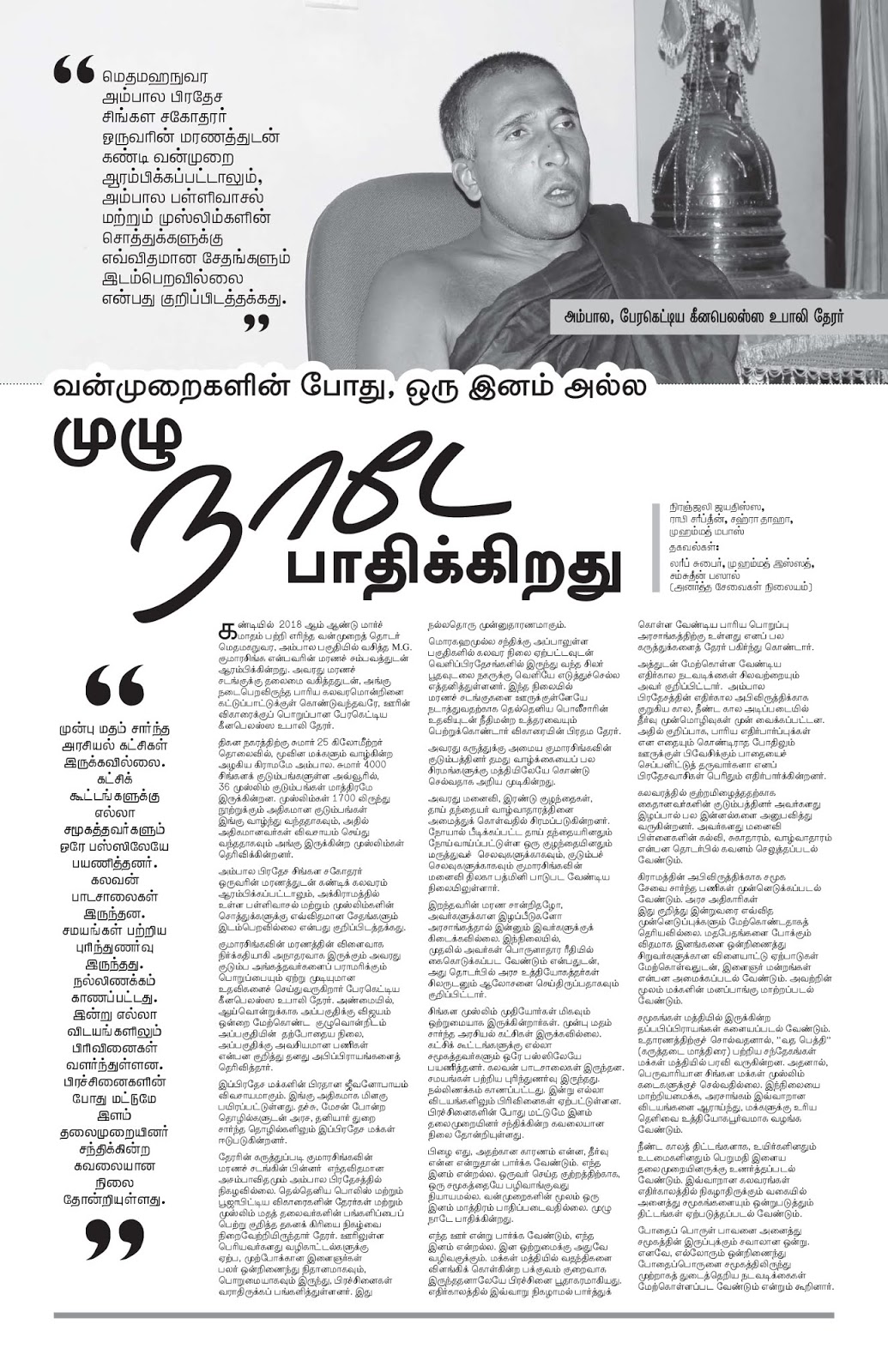
Perakatiya Thero on Mob Violence in Kandy - Newsview (August 20I8)
Get link
Facebook
X
Pinterest
Email
Other Apps
" When violence occurs, not only a particular community but the whole nation suffer"
Perakatiya Thero on Mob Violence in Kandy - Newsview (August 20I8)
What is Disaster Information Management System Background Population growth and urbanization processes, trends in land use, increasing impoverishment of significant segments of the population, use of inappropriate technological systems in the construction of houses and basic infrastructure, and inappropriate organization systems, amongst others, are factors that have increased the vulnerability of the population vis-a-vis the wide diversity of physical and natural events. However, lack of systematic, homogeneous, and compatible records of disaster typologies, understood as the effect of the occurrence of threatening events on the vulnerability of country, on the one hand, and insistence on considering disasters only as effects of events of huge proportions and high impact, on the other, have hidden the thousands of small and medium scale disasters that occur every year in country. In this context, The Disaster Management Centre (DMC) of the Ministry of Disaster Management an...
Tropical Climate undertakes Social Service related to Disasters, Vulnerable, and for Environment and Climate. Below described our Social Service work starting with our relief for recent violence starting from 5th March of 2018 and for this we have established a recover support centre and network. We described the disaster recovery centre network below followed by the institutional information about social service work of tropicalclimate. Disaster Services Centre The Disaster Services Centre (DSC) provides services for risk management and recovery. Initially, we shall assist those affected by the mob violence that took place in Digana and the surrounding areas in March 2018 Our office is in an accessible location in Kengalla. A small staff at this office shall be supported by the larger staff of Federation for Environment Climate and Technology (FECT) and Tropical Climate (TC). The Centre has IT, administration, counselling and small meeting spaces. We are conducting some c...
Tamil Journalism Class and Meeting of Samsudeen Fazal I was able to join the class, of upgrading Tamil journalism in the central province of Sri Lanka at Akurana, a two days program on 2018.07.07/08 starting at 9.00am. The class was lectured by Seevagan Poopalaratnam (London BBC Tamil news editor) Mob: 071-3999091 – London: 0044 77 69 35 44 09 Email:seevagan@hotmail.com / www.arangamnews.com The subject was: How to do research, Television, and radio Remark: we went to meet two persons who met with an accident in Akurana. This taught us to take photos and videos from that place and articulate a report. The programme helped us to also structure an interview and present the findings in a suitable manner. And one person contacted me over the phone on Saturday. He said to me I like to see you but I can’t because he told me that he could not see or walk in a condition that could not happen anyway. In my eyes, tears dropped As so...


Comments
Post a Comment